artist

The Story of the Blue Eyes

Once upon a time, there was a young artist who had eyes of unusual bright blue colour. They exuded the creativity, curiosity and innocence with which he looked at the world and his fellow human beings.

The ‘Blue Eyed Artist’, as he was known, lived in an unassuming little house, which was surrounded by an evil metropolis. Unknown to his wicked landlord, the house was a refuge for fellow artists, bohemians, mavericks and other subversive elements from all over the city. They would gather there to exchange ideas, recite poetry or debate the metropolis and its merciless energy.

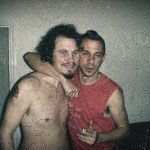
One fine evening, a small festivity was taking place in the parlour of the house, when a fellow artist said to the host: ‘Through your blue eyes, I can see your soul! Let me take an image thereof.’ To this, a heated debate ensued on whether an image can take a person’s soul, for good or for bad. The Blue Eyed Artist stayed quiet, at first.

‘I trust in art,’ suddenly, said he, ‘and I trust in you, my Fellow! Take my image.’ And so his image was taken.

The years went by, and the wicked landlord demanded ever more rent, so the Blue Eyed Artist had to go forth and try his luck in the evil city, let it cost what it will.

He soon lost his friends, only to find new ones of the shallow kind, and started to worship insatiable mechanisms that measure the world in zeros and ones. Yet he earned great respect for creating commercial effigies, coordinating communications for global entities and developing interfaces that allow humans to interact with machines. He was known as the ‘Blue Eyed Master’ now, and his creativity, eloquence and personality were highly regarded amongst his peers.

One day, he went on a secret assignment to an undisclosed location, where high-net-worth individuals would regularly congregate to indulge in the nectar of the green Siren. The Blue Eyed Master had gone there to sell retail concepts to unsuspecting international property developers.

He was just about to conclude an important transaction, when suddenly his evil communications device vibrated. An anonymous source had sent him a message containing nothing but a link to a subversive left wing news outlet. A shiver ran down the Blue Eyed Master’s spine. He paused for a moment and with a sense of foreboding, followed the link.

Thereupon, he was looking at a photo of himself, staring at the camera with his blue eyes. Underneath, was written: ‘Would you trust this man?’, followed by a scientific explanation of why men with cold blue eyes are untrustworthy human beings.

After a moment of shock and disbelief, he realised that he was looking at his own self as a young man in the little house many years ago. Long had he felt that he was selling his soul to the devil. Yet looking at his own mirror image, he understood that he himself, in fact, was the ‘Blue Eyed Devil’.

The Story of the Blue Eyes Read More »
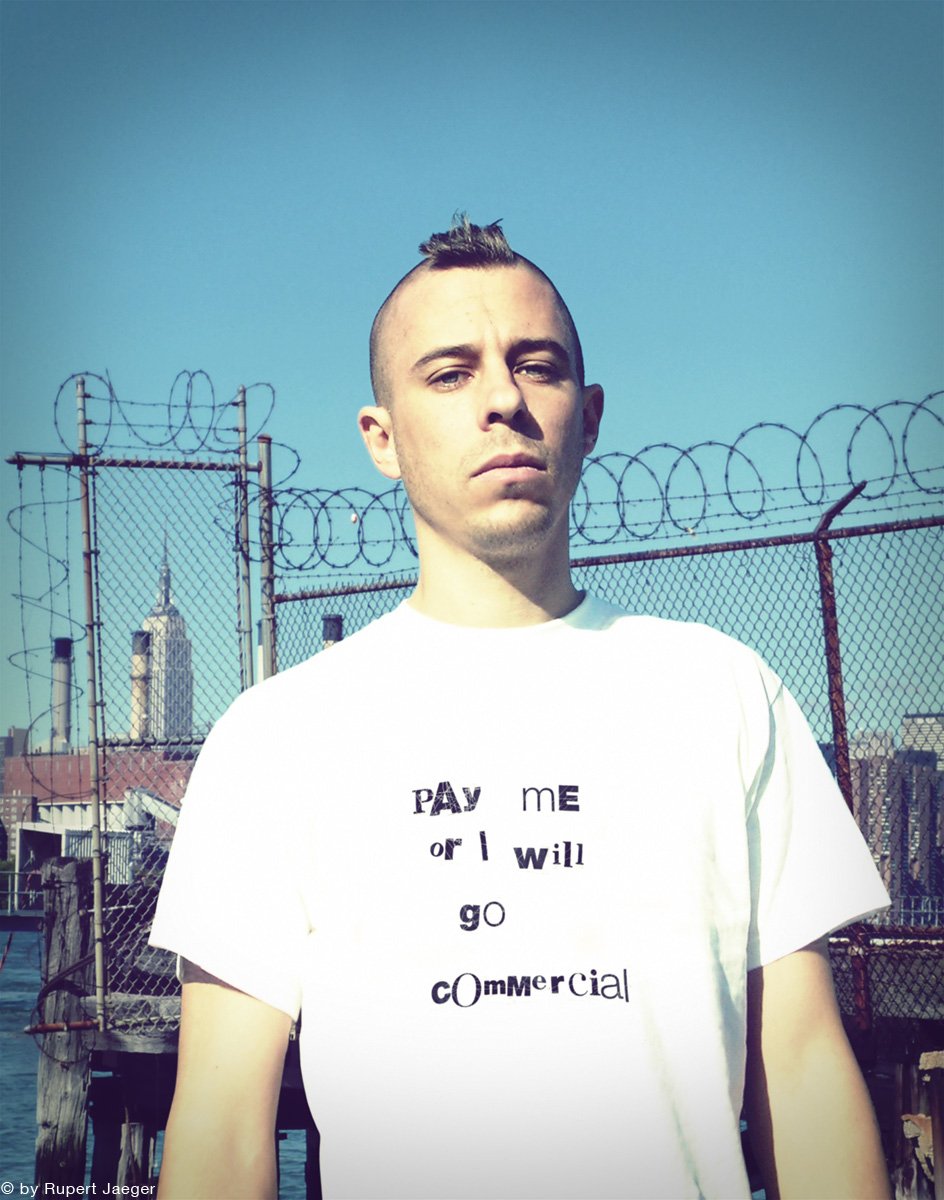
Pay Me or I will go Commercial

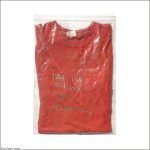
This garment is a must-have for any artist, singer, musician, filmmaker or anyone else trying to make it in the creative industry. Show who you are, what you want and what you’re made of. In other words, show how far you are willing to bend over in this cut- throat industry. You will not make this statement in vain!
This vintage item has nostalgic value and is available new – in all sizes and 2 different colours – or in its original, worn, sleeveless version from the rebellious early 2000’s.


© by Rupert Jaeger, all rights reserved

Pay Me or I will go Commercial Read More »
The Nostalgia Machine

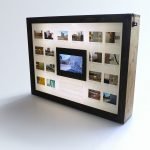
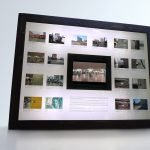
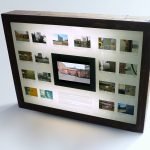
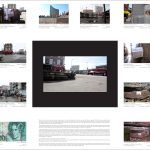
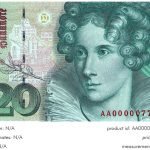
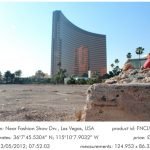
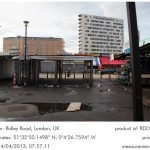
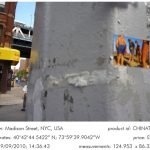
‘The Nostalgia Machine’ was the second installation, where I combined (back)-lit still images with video, after the ‘Surreal Business Cycle’ a few months earlier. This time it was in the form of a traditional light box, with an opaque, back-lit plexiglass on the front that had a number of images and text printed on, and a video screen fixed in the centre of the plexiglass.

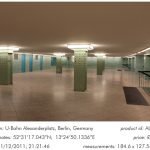
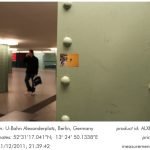
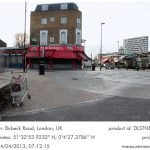
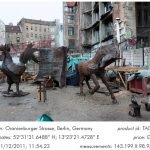
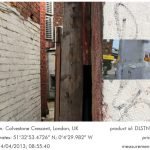
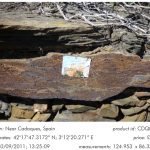
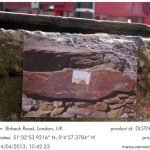
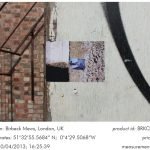
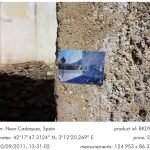
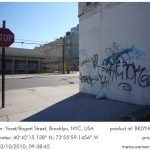
The video in the centre of the light box is about 20 minutes long and plays on a loop. It consists mainly of stop-frame animations, following the trail of printed stickers in various locations, whereby each sticker depicts an image of the pervious location. The camera, in stop frame manner, continuously moves towards or away from each sticker, and then jumps to the previous or next location, thereby creating the illusion of ‘flying’ from on place to the other. The stickers were placed in particular places within (mostly) urban environments, in various cities and different points in time. All of the trails converge on ‘Ridley Road Market’ in Dalston, London, in spring 2013, which becomes the focal point of this journey into memories and urban space.

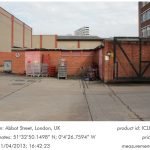
The images on the light box show the key moments of each time/space trail and are accompanied by the precise location and moment in time of capture. This key image also becomes the sticker for any subsequent potential trail, and in such cases is accompanied by the measurements of the stickers and its price of sale.

The text, underneath the video, describes the workings of the Nostalgia Machine in technical detail:

‘Beauty and Love were frozen: Seven years, three months, two days, twenty-three hours, fifty-nine minutes and thirty-one seconds. After that they were simply absent, non-existent. In this emotional vacuum devoid of strong affection and personal attachment and without any perceptual experience of pleasure, meaning or satisfaction, a structure slowly became apparent that would eventually display characteristics akin to notions of beauty and love: Time, reflected through the abstract arrangement of inter-related, interconnected and interwoven points, instances and moments.

The most critical of all points in this structure is what could be called the point of inversion. At this point, all previous moments, which were irrelevant at their time of occurrence, and the abstract arrangement as a whole, which was hitherto unaware of its own existence, take on a retrospective meaning that transcends ideas of nostalgia, as the true meaning does not lie in any properties the points may reflect, but in the pure appreciation of the moment(s) as an experience of time itself.

In appreciating this pure experience of time lies the true beauty and love of the process, while the structure, as an abstract arrangement, is the manifestation of this process. Images, however destructive and obstructive to the process in general, are instrumental in a number of ways, but have to be defended against the attacks of the ‘Nostalgia Machine’, which would logically attempt to intrude and infiltrate the process, thereby rendering it ineffective and incorporating the process in the Nostalgia Machine’s all encompassing representation of life as an audio and visual surface of perceived properties of beauty and love. The Nostalgia Machine’s inherent propensity to fictionalize life functions proportionally successful to its ability of presenting an ever perfecting narrative, seemingly in tune with the eternal rhythm of beauty and love. ‘The process’ must resist such tendencies and embrace the sensual pleasures of time without notions of past and future. This effort of identifying narrative-free moments in time can only succeed, if the following two preconditions are observed:

(1): the selection of images need to follow a ‘process’ of elimination.
Each identified moment is to be positioned against a set of images, which must gradually decrease in numbers for each successive moment until the point of inversion is reached, the precise occurrence of which is identified through one single image.

(2): While the use of seemingly nostalgia laden images creates a growing emotional attachment to each moment in time, the experience of this emotional attachment has to become less personal with each successive moment. At the point of inversion, one single image, intolerably nostalgia laden, yet devoid of personal memories, breaks the memory-nostalgia relation, which results in a climactic experience, at once full of euphoric revelation and profound disappointment.’

[…]

© by Rupert Jaeger 2013

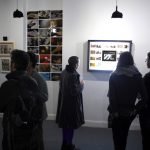
‘The Nostalgia Machine’ was shown as part of the ‘Mnemonic City’ series. It was shown at the Doomed Gallery in Dalston, London, just off Ridley Road Market under the banner ‘Mnemonic City: Moving Streets’ with other work of 10 artists of Magma Collective.

The dimensions of the light box are 90 x 65 x 14 cm.

The Nostalgia Machine Read More »
Inner Peace

inner_peace_0011

This soft, comfortable, eco- and animal-friendly produced T-Shirt, is the perfect garment for meditations, yoga, or any other spiritual activities.
Outside of the spiritual home, it’ll make sure you’ll always give out the right vibes to the people around you…


© by Rupert Jaeger, all rights reserved

Inner Peace Read More »
Family Tree

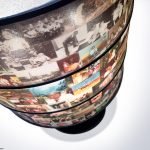
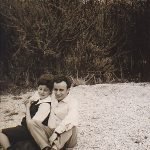
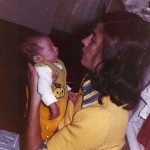
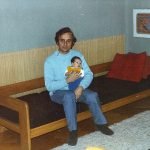
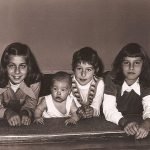
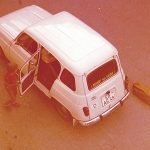
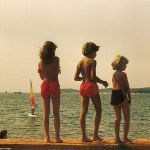
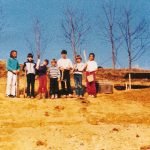
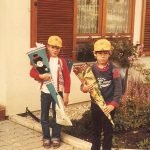
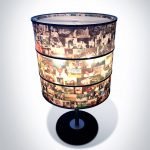
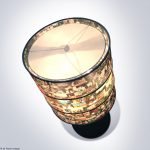
For my parents wedding anniversary in 2012 I produced Family Tree, a lamp with a lampshade that’s made up from family photographs, covering the lives of my parents – from when they were born – their six children and 7 grand children (with 2 more on their way).

Measurements
Diameter: 33cm
Height: 30cm (60cm including stand)
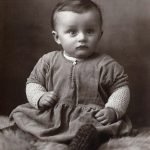
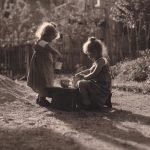
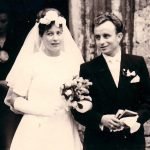
Below is a small selection of photos from the lampshade.


© by Rupert Jaeger, all rights reserved

Family Tree Read More »
My First Blog Post

Everyone want’s a blog, right?…well, me too, but this is my first post and it’s June 2013, so I am not exactly setting a trend here. Don’t get me wrong, I am generally quite net and media savvy and have actually set up and written for a few blogs, but they were not mine. So, this post, published at 09:29:56 (BST) on the 21st of June 2013, is my first own blog post ever. And therefore I feel compelled to talk a bit about myself, what I do and what I intend to blog about. And this, I hope, will help you, my audience, to make a judgment on whether this blog is worth a regular read.

Let me begin:

Who Am I?

I am one of those ‘creative individuals’ who’s been trying to find a place somewhere in the spectrum between true artistic expression and commercial succes. In other words,  I am floating between living the life of a penniless artist and selling my soul to the devil.
Sounds familiar? I know, there is a whole army of us out there, a generation of people who grew up with the desire to express our individuality and fulfil our true creative potential, only to end up pushing pixels for Beelzebub.
Gadzooks, I am being extreme! Of course it’s not all that bad, but I do feel sometimes as if I have fallen prey to a clever ploy to establish a new type of slavery. We work for free, without contracts, benefits or any sense of security, all in the name of expressing our creativity.
I wonder how many of us will be able to afford a dentist when our teeth start falling out.

What Do I Do?

Now let me elaborate how the above abstract analysis translates into the particular reality of my existence:
I make a living as Head of Communications for an international architecture firm, which builds properties, mostly large shopping centre complexes all around the globe. It can be pretty exciting work, I get around quite a bit, helping to find new clients and projects, winning awards and expanding the business in general. What’s on the other end of our operations is too far removed from my job for me to really make a judgement on whether the results of my work are for the good or detriment of humankind.
In stark contrast to that are my artistic ambitions and the life and social environment that come with it. I live in a warehouse community in North London, sharing my existence with artists,  left-wing liberals and hippies. My artistic practice revolves around issues of history, cities, places of memory and the reflection of those through images as objects. The two obsessions of my life are the concept of time and America. My preferred media are photography, film/video and writing, usually brought together in some kind of narrative.
Add to all of that an interest in politics and economics, in particular the state of Europe at this moment in time, and you might understand next time you see me walking around Finsbury Park with a can of cider in my hand.

Is This Worth A Read?

I’ll leave that to you to decide, but if my brief introduction made you just a little curious, then do come back, because I intend to create regular posts that draw inspiration from my somewhat contradictory life and the experiences around it. And of course I’ll present  my art to you, keep you posted on exhibitions, events and happenings, and last but not least, I’ll let you in on on a little secret of mine.
© by Rupert Jaeger, all rights reserved

My First Blog Post Read More »